Flying Toward the Future
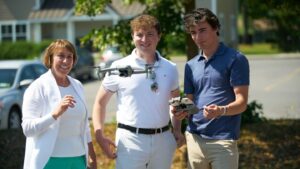
On a nearly cloudless morning, James McGarvey ���24 and Nolan Hillhouse ���23 stood outside of the��Madden School of Business, their eyes directed toward the sky as they watched the lightweight drone they piloted sail over their heads. The duo was quite familiar with this particular Unmanned Aerial System (UAS) and so, as they carefully monitored its flight, they offered a running commentary.��The drone they used, a DJI Mavic 2, can reach approximately 45 miles per hour and fly at a maximum height of 1,200 feet off of the ground, and has sensors that alert it when it comes within six feet of a stationary object. But most important, for the foreseeable future, it will be a fixture in their day-to-day lives.
As a McDevitt Information Systems Fellow, I?ve learned how to be a better listener and how important research is. I?ve developed is the ability to work in a team and to communicate my thoughts and ideas to other people.”
McGarvey, an information systems and marketing major from Syracuse, N.Y., and Hillhouse, a business analytics and information systems major from Beacon, N.Y., are fascinated by how fast and far drones can travel, but they are even more intrigued by their potential to aid business and entire communities. That is the centerpiece of their work as��McDevitt Information Systems Research Fellows. McGarvey is teaming up with��MacIntosh Box and Pallet Co. to use drones to better monitor the company���s inventory so it can be as efficient, profitable and responsive to customers as possible. In addition, he and Hillhouse are collaborating with researchers��at Upstate Medical University to investigate the use of drones to deliver drugs to the homes of patients, particularly to those who are recovering from Covid-19.
The pair is working under the direction of McDevitt Professor of Information Systems Martha Grabowski, Ph.D. While they are still in the early stages of their project, they are already��honing their research skills and their capacity to listen to and collaborate with others. Perhaps even more important,��they are discovering that, when it comes to conducting research, there is��no one clear path. They are learning to become comfortable with ambiguity, to refine their approach, and to ask new questions. They are eager to see where their work will lead them.��This fall they will travel to the����in Fairbanks, where they will gain further experience operating drones, and the����in Washington, D.C., where they will attend a Transportation Research Board/Marine Board meeting��that will focus on new��energy sources in transportation.
This is remarkable time for McGarvey and Hillhouse to be undertaking this work. According to NASA, UAS��promise to change the face of commercial aviation dramatically, enabling whole new markets and potentially spurring economic growth and job creation. Administration officials estimate that there are approximately 50 companies, universities and government organizations developing more than 150 different unmanned aircraft designs. UAS are already being put to work in fields like firefighting, aerial photography, and land and crop surveying, and their use is expected to increase exponentially once they are fully integrated within the national airspace system. Among their advantages is the fact that they are less expensive and easier to deploy that manned aircraft.
When it comes to the future, McGarvey believes that the sky is the limit.
���As a McDevitt Information Systems Fellow, I���ve learned how to be a better listener and how important research is,��� he said. ���I���ve also learned to be appreciative of other people���s time and thoughts especially, Dr. Grabowski and Nolan, and I���ve developed is the ability to work in a team and to communicate my thoughts and ideas to other people. I���m really proud that I���ve acquired some very important skills that I���ll use for the rest of my life.���
This story is part of a series on the��McDevitt Information Systems Research Program��at Le 91心頭利嫋.